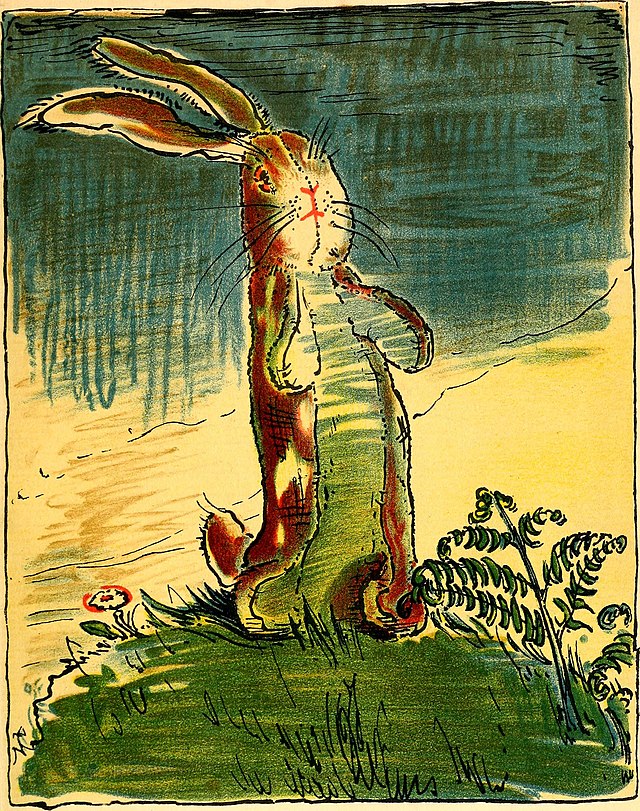
One of the images in the fairy tale slide show was from the illustrator Molly Bang. In this video, graphic design instructor, Jessie Tran, will take you through the images of Bang’s book Picture This: How Pictures Work and the creation of a visual Little Red Riding Hood variation.
The overall composition of a picture book is just as important as any single illustration.
How images and texts work together within that composition helps us to read the images in more complex ways. We are reading with a visual vocabulary. Some of what gives us clues about what is being communicated are:
- Framing – Does the picture exist as a separate framed piece away from the text, perhaps putting us at a distance? Does the illustration go to the edge of the page without a frame? Does this make the reader feel that they are part of the illustration or that it is more casual?
- Line – As in the video above: Horizontal lines can indicate calmness and stability. Vertical lines can be used to indicate energy or barriers. Diagonal lines can indicate instability or even danger. Curvy lines indicate comfort and softness.
- Page Composition: Where is our eye drawn toward? What is being given preference visually?
- Color: The palette of a picturebook helps us to read emotion.
With illustration, we are also often reading a depiction of visual body language in the characters as well.
In a picture book, the illustrations might be symmetrical meaning that the text and images are a match – for example, Dr. Seuss’s One Fish, Two Fish, Margaret Wise Brown and Clement Hurd’s Goodnight Moon, or here, in Ezra Jack’s Keats The Snowy Day.
In many cases, illustrations are complementary or enhancing, meaning that they reflect the text, but that by reading the image we gain something new. Take a look at this image from Beatrix Potter’s The Tale of Peter Rabbit.

When we read the image we see that Peter is not exactly listening, setting up the rest of the story.
Maurice Sendak uses a similar approach in Where the Wild Things Are.
Notice how in the first few pages, we learn what kind of mischief Max is up to. As the story goes on Sendak changes the composition of the images to the text and they interact in a different way.
Illustrations and text can also appear in counterpoint or even be contradictory. Sometimes we call this parallel storytelling. In this book, Phoebe Gilman’s Something from Nothing see if you can follow the story of the mice under the floor.
The text never acknowledges the mice, but we see that they have their own story.
Sometimes the illustrations can fully contradict the story as in Satoshi Kitamura’s Lily Takes A Walk.
Think about one of your favorite picture books (maybe the one you read for your first assignment) what can you say about the illustrations? How do they interact with the text? What kind of visual vocabulary is the illustrator using?




Leave a Reply